Get The Ring Right
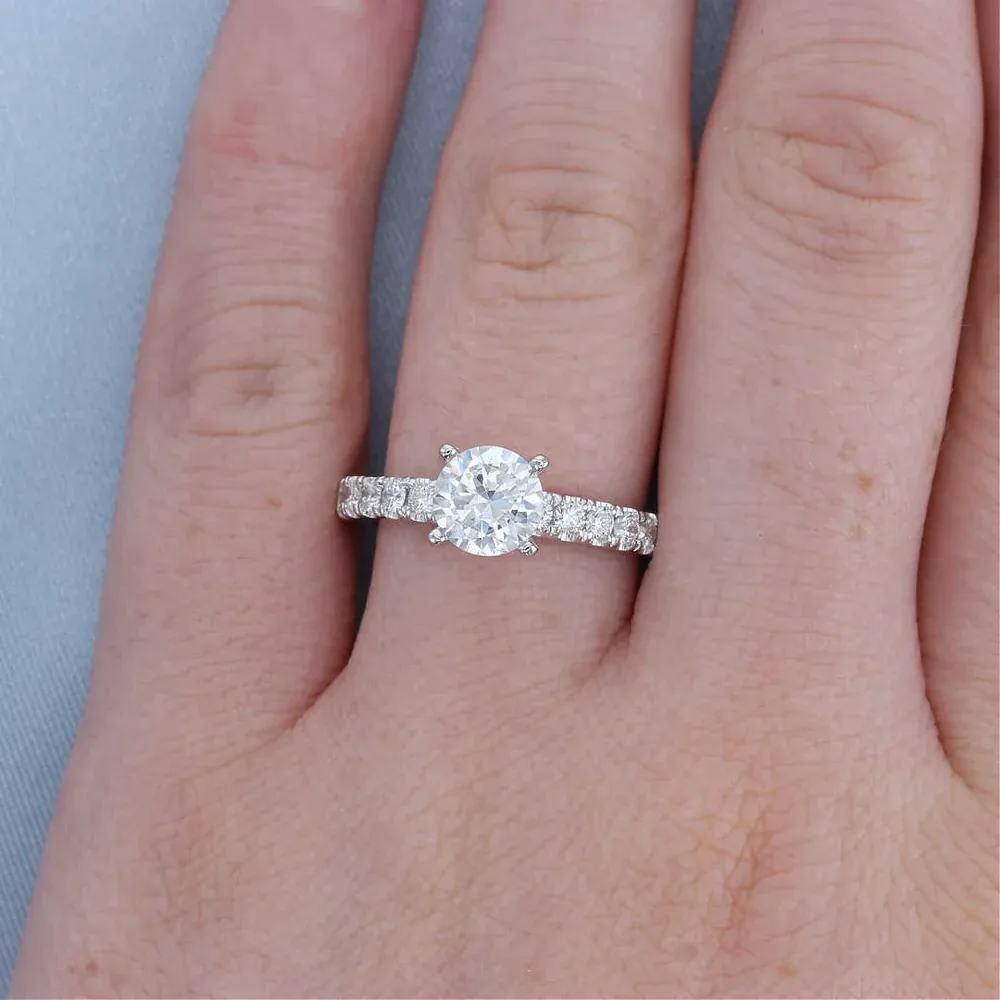
Round diamond engagement ring with a pave band modeled on a hand

Methodology - updated August 17, 2026

How 529 ring designs become one usable answer.

The study is designed to cover the mainstream U.S. shape distribution before narrowing toward her positive responses. This page states what the catalog represents, how choices affect selection, and where a jeweler must take over.

Catalog evidence

A controlled visual library, not an endless product feed.

Every swipe image is stored locally so the survey does not depend on third-party image latency. Source and product provenance remain attached for public-match results.

529unique, hand-modeled color ring photos
386distinct shape, metal, setting, and band combinations
8principal center-stone shapes in the sampling model
7visual sources represented in the swipe catalog

What the 95% statement means

The catalog's eight principal shape targets are round, oval, emerald, princess, pear, marquise, cushion, and radiant. The underlying 2025 U.S. study reported round at 26%, oval at 25%, emerald, princess, pear, and marquise at 8% each, and cushion and radiant at 6% each. Together, those reported categories total 95%.

Source: The Knot 2025 Real Weddings Study data readout, based on 10,474 U.S. couples married during 2025.

The 95% figure describes the reported center-shape categories represented by the sampling model. It does not mean the catalog contains 95% of every ring ever sold, and it does not claim that center shape alone determines preference.

How the catalog is distributed

The 529-image library is normalized to the eight-shape target rather than allowing whichever source has the most photos to dominate the deck. Automated tests keep the overall shape distribution within three percentage points of the normalized target.

Popular shape families receive more examples and closer variations. Less common design families remain available but are less likely to dominate the initial survey. The catalog currently includes more than 380 distinct shape, metal, setting, and band combinations.

How images are admitted

Survey photos must be color images, show the ring modeled on a hand, keep the ring visually apparent, and avoid faces or unrelated jewelry as the main subject. The 408-image high-resolution expansion also carries a machine-audited hand-only, color, close-up classification, a minimum 800-pixel short edge, and a stored sharpness score.

Every image is converted to an immutable WebP asset. Catalog identifiers and image files are unique, so the same image is not shown twice within a survey. Product-source URLs remain in the record for provenance and closest-match delivery.

How descriptors are controlled

Each record identifies shape, metal, setting, band, profile, stone color, design family, source, and product URL. Automated descriptor rules compare the normalized description against the product and photo evidence. Catalog tests currently require zero unresolved descriptor conflicts.

Fourteen official Tiffany & Co. product records add metadata-only coverage to public-match ranking. Tiffany images are not copied into the swipe deck.

Adaptive selection

Explore first, then move toward positive evidence.

The selector balances coverage with convergence rather than optimizing for YES responses from the first card.

01

Breadth phase

The first 20 counted swipes cover all eight principal shapes, at least five metals, and at least eight settings while avoiding tail overexposure.

02

Preference update

Each valid response updates attribute scores. Dwell time, drag distance, and certainty affect response weight; interactions under 0.25 seconds are retained for audit but excluded from modeling.

03

Similarity-guided depth

After breadth coverage, candidates closer to positive rings receive more priority while diversity penalties prevent the deck from collapsing into repeated near-duplicates.

When the study stops

The standard path requires at least 30 counted responses and six positive choices. If six positives have not appeared, the survey continues. A separate hard stop closes the survey after 80 counted NO responses so it cannot become open-ended.

The result combines attribute evidence, a closest catalog ring, and a closest public product reference. When the evidence does not support a firm dislike, the result says so instead of manufacturing certainty.

What the method cannot determine

Visual swipes cannot establish ring size, exact carat weight, stone quality, center dimensions, alloy, prong thickness, setting tolerances, structural durability, or final cost. The visual concept is not production CAD. A qualified jeweler must confirm those decisions before manufacture.

The method is intended to answer one practical question well: which visible ring direction should the purchaser inspect and discuss with a jeweler?

See what this method produces.

Review the ring direction, evidence, public match, and jeweler handoff from a completed study.

See a real result